|
Marie Watt
2008 Portland Art Museum Contemporary Northwest Art Award Exhibition
June 14 - September 14
Read more about the exhibition here at PortlandArt.net
Click on an image to enlarge:
 |
 |
2008 Greg Kucera Gallery Installation Views
|
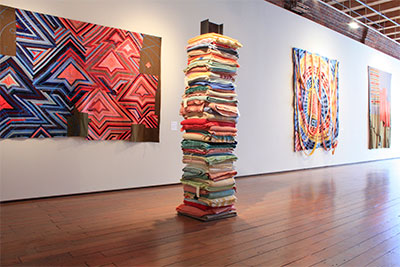
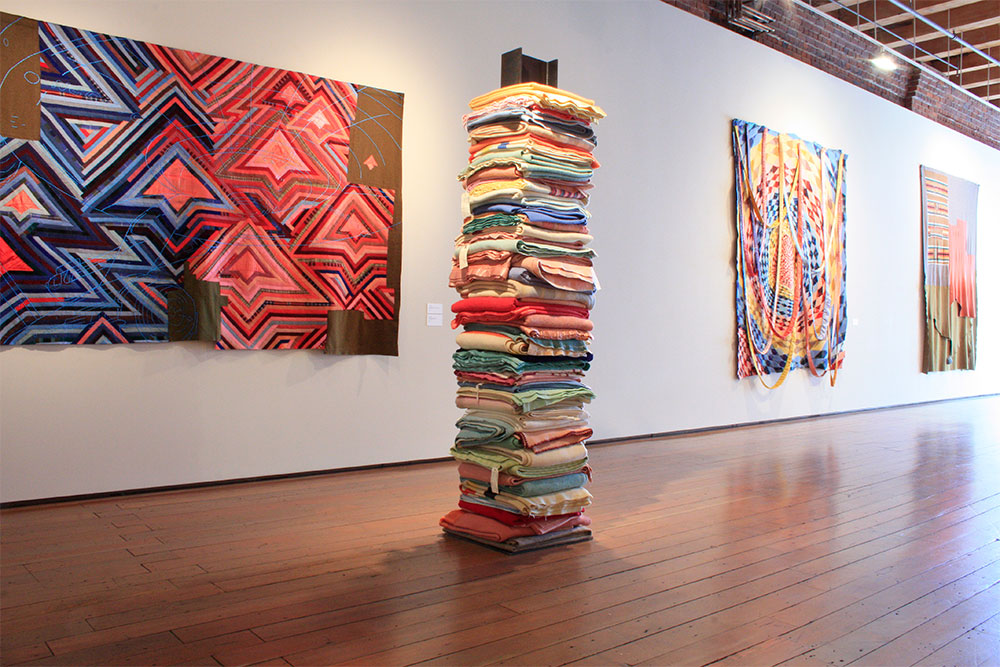
Left: SUSAN B. ANTHONY WITH WOODLAND INFLUENCES, 2008
Center: CANOPY: LEDGER, 2007
Right: STADIUM: JIM THORPE AND RELATIONS, 2008
|
 |
 |
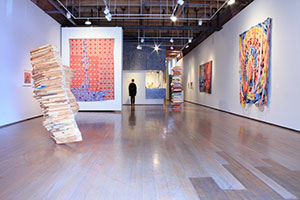
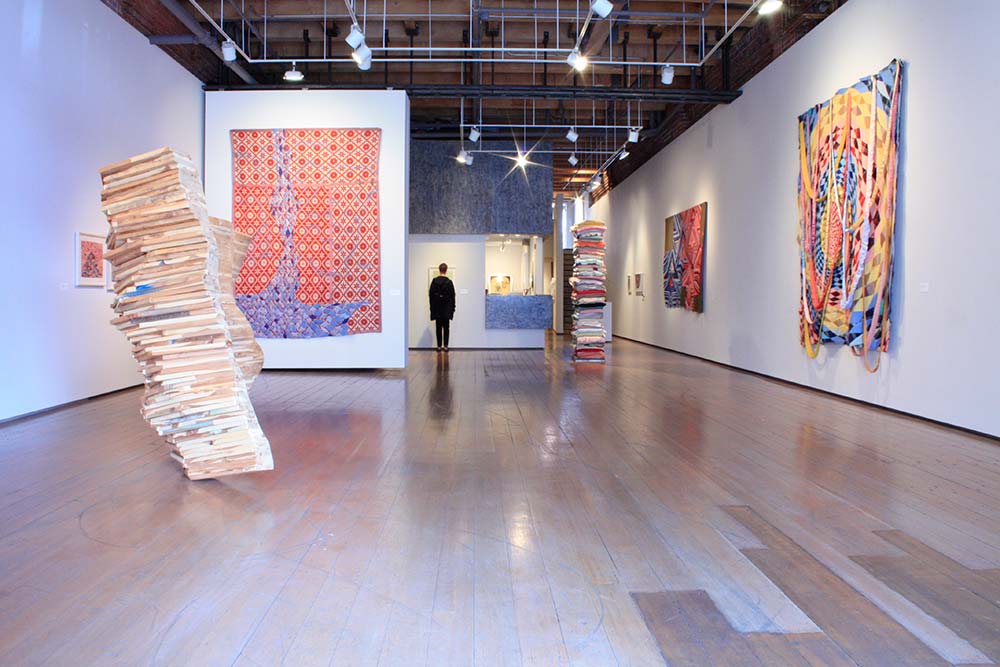
Left: CANOPY (OMPHALOS), 2007
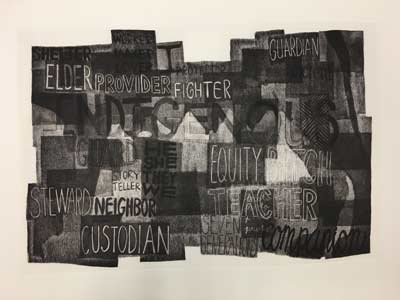
Center Wall: CUSTODIAN, 2007
Right: GREAT REGISTRY: LEDGER, 2008
|
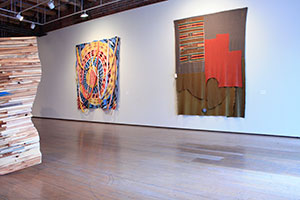
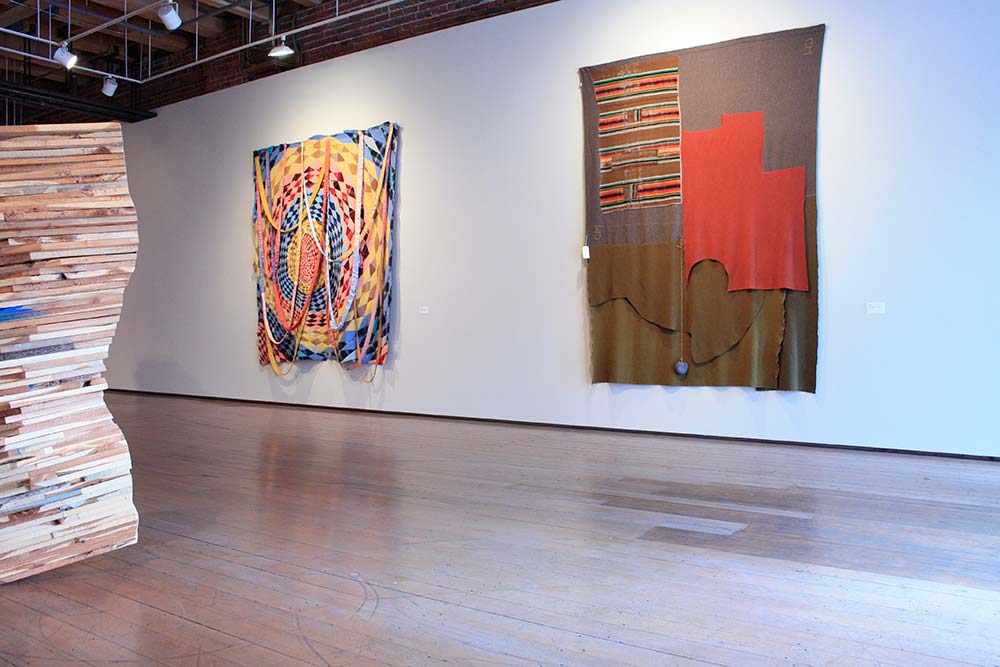
Left: BLANKET STORIES: CUSTODIAN, SEALTH, RISING SUN, ANCIENT ONES, AND ALL MY RELATIONS, 2008
Right: GREAT REGISTRY: LEDGER, 2008
|
CANOPY: LEDGER, 2007
Wood, wool blankets, satic binding
53 x 15 x 15 inches
$28,000
CANOPY (OMPHALOS), 2007
Wood
94 x 13 x 13 inches
SOLD

STAFF: CUSTODIAN, 2006
Cast bronze on cedar base
117 x 4 x 4 inches, base, 1 x 18.25 x 18.25 inches
$28,000

Installation view and detail
SHELL, 2005
Bronze and wool with cedar base
2.5 x 5.75 x 5.75 inches
Edition of 10
$900
NURSE LOG: HEIRLOOM, 2006
Unique cast bronze
Dimensions vary
$3,000
Greg Kucera Gallery is excited to announce its first one person exhibition by Northwest artist, Marie Watt. Many of the pieces in this show relate to the idea of "Six Degrees and Seven Generations", which references two theories of connecting people. One theory says that everyone can be linked to everyone else in the world by no more than "six degrees of separation". The other theory is an Iroquois and indigenous people’s philosophy which states that our actions and decisions not only shape the next seven generations, but have also been affected by those seven generations prior. Watt creates narratives within her work by drawing together a collection of images that connect native people with events and individuals from western civilization.
Watt draws on her heritage as a woman, a Native American, and as an artist. Using wool blankets and their history of being handed down from generation to generation, the artist explores the human stories found within these everyday objects. Blankets provide shelter and protection, conjuring up images of security and home.
WORRY STONE (pink pouch), 2007
Bronze and reclaimed wool blankets
Dimensions vary
Variable edition of 30
$700
WORRY STONE (blue pouch 2), 2007
Bronze and reclaimed wool blankets
Dimensions vary
Variable edition of 30
$700
"Freud considered blankets as ‘transitional’ objects, but I like to consider how these humble pieces of cloth are transformational. Blankets are a part of how we are received into the world and also how we depart this world. Blankets are used for warmth and shelter. Children use them for hiding and to construct impromptu forts. A blanket is a catcher of dreams and ledger of secrets. Wool blankets are the pelts of our animal relatives, the sheep. Blankets are body-like.
Blankets are also very personal to me. I am Seneca, one of the six tribes that make up the Iroquois Nation, and in my tribe and native communities, we give away blankets to honor people for being witness to important life events. In this way, it is as much of an honor to give away a blanket as it is to receive one. Ultimately, wool blankets are simple objects with stories that connect us." —Marie Watt

CUSTODIAN, 2007
Reclaimed wool, thread, hand sewn
107 x 112.5 inches
$15,000
STADIUM: JIM THORPE AND RELATIONS, 2008
Reclaimed wool, thread, shedded antlers hand sewn on Pendleton Stadium blanket
63 x 73 inches
$12,000
About the artwork: STADIUM: JIM THORPE AND RELATIONS (Pop Warner, Dwight Eisenhower, George S. Patton, Babe Ruth, Michael Jordan, Sonny Sixkiller and Animal Relatives)
Detail from Stadium:
Jim Thorpe and Relations, 2008“Jim Thorpe (1888-1953) is arguably the greatest all-around athlete of the 20th Century. He was raised on the Sauk and Fox (Mesquakie) Nation of Oklahoma and was of European (Irish/French) and Native American decent. His boyhood was marked by the early death and loss of his twin brother to pneumonia, his mother to complications of childbirth, and later his father to gangrene poisoning associated with a hunting accident.
Thorpe eventually attended the Carlisle Indian Industrial School. In 1907 he begins his athletic career with participation in track and field, football, baseball, lacrosse and even ballroom dancing.”—Marie Watt
“ Thorpe gained national attention as a football player. In a 1911 game against Harvard, the Carlisle team, led by Thorpe, won in a 18-15 upset. In 1912 Carlise went to the National Collegiate Championships against West Point’s Army team. In this game Army player Dwight Eisenhower (1890-1969) attempts to tackle Thorpe and injures his knee. It is also interesting to note that Eisenhower, Texas born and a Kansas farmboy, aspired to be a professional baseball player and one of his greatest disappointments at West Point is that he never qualified to play on the Army baseball team. As for the Carlisle-Army game, Carlisle had a 27-6 victory over Army and finished 11-1 that season. Thorpe was bestowed All-American Honors for his 1911 and 1912 seasons.”—Marie Watt
“The coach of Carlisle between 1999-1903 and again from 1907-1914 was Glenn Scobey “Pop” Warner (1871-1954). Warner and the Carlisle team are credited for changing the American football playbook. Where the Carlisle team lacked the physical bulk and height that was typical of football teams of this period, they had speed and finesse. This helped change football from an aggressive wrestling match to a running game. Pop Warner further contributed innovations including the screen pass, spiral punt, as well as single and double wing formations. In addition to his 44 year coaching legacy that included 319 NCAA College football wins, Warner is credited with founding the Pop Warner league, an American football youth organization, which continues to thrive today.”—Marie Watt
“Jim Thorpe went on to participate in the 1912 summer Olympics in Stockholm, Sweden where he competed in the modern pentathlon and decathlon. One of his modern pentathlon teammates included the young George S. Patton (1885-1945). While Patton finished 7th, Thorpe received the gold medal in both events. Upon retuning to the United States, a ticker tape parade in NYC on Broadway was thrown in his honor. This celebration was cut short 6 months later when Thorpe was accused of playing professional baseball for two summers and thus, stripped of his medals. This contested action took place despite International Olympic Committee (IOC) rules stating that protests had to be made within 30 days from the closing of the ceremonies of the games. One of the people who lead the campaign against Thorpe was Avery Brundage who was Thorpe’s pentathlon teammate and a future IOC President. At this time in history it was typical for college athletes to play summer pro-baseball for meager pay; reputedly incomes were as low as $2 game or $35/week. Thorpe's gold medals were reinstated 30 years after his death in 1983.”—Marie Watt
“ After the Olympic controversy Thorpe was declared a free agent and was swiftly recruited to play professional baseball, football and basketball. Between 1913 to 1922, Thorpe played baseball for the New York Giants, The Cinicinnati Reds, and the Boston Braves. He amassed 91 runs scored, 82 runs batted in, and a .252 batting average in 289 games. Jim Thorpe’s favorite game was football. He played for the Canton Bulldogs from 1915 to 1920. He also played on six NFL teams between 1920-28 playing 52 NFL games. Thorpe was also a part of two teams composed entirely of Native American players including the World Famous Indians (WFI) and the Oorang Indians teams stationed in LaRue, Ohio, that barnstormed from 1926-28 playing football, basketball and baseball games throughout parts of New York Pennsylvania and Ohio. In the 1999 AP poles Thorpe was voted as being third most important athlete of the century behind Babe Ruth (1895-1948) and Michael Jordan (1963- ).”—Marie Watt
“After his successful athletic career, Thorpe worked odd jobs and in his final years lived in abject poverty. Throughout his life he battled with alcoholism. Following Thorpe’s death in 1953 his third wife, Patricia, sold his name and ashes (against the wishes of his children) to the town of Mauch Chunk, Pennsylvania. Mouch Chunk purchased Thorpe’s remains, dedicated a monument to him and renamed their city in his honor despite the fact that Thorpe had never been to Mauch Chunk.”—Marie Watt
“Sonny Sixkiller, the University of Washington start quarterback from the 1970’s is also recognized with a cameo. Sonny Sixkiller is Cherokee and was raised in Ashland,Oregon. In my youth he was held up as a role model and celebrated for rescuing a team that had a 1-9 season a year prior to his arrival. In 1970 he led the nation in passing. In 1971 he appeared on the cover of Sports Illustrated, only one of three people in the history of the University of Washington Husky history, to receive this honor. While no one in my family ever attended the UW, my mom moved from upstate New York to Washington to work at the University of Washington Hospital as a nurse. My father moved to Seattle with an Engineering degree from the other UW, University of Wyoming. My parents have had Husky season tickets for as long as I can remember. One year my dad won a trip to the Rose Bowl as a result of the Guess Guesser. My father’s family is Scott and German; it is not lost on me that the stadium blanket is a Pendleton tartan plaid.
Additional notes: On the palette: Thorpe’s relates to a sepia photo with hand colored red elements; Patton similarly references a hand painted photo. Pop Warner’s palette might be compared to a black and white photo. Eisenhower’s blue palette refers to the engraved postage stamp from which the image is derived. Sonny Sixkiller is more akin to a color photo. Babe Ruth and Michael Jordan are presented in black and white Victorian silhouettes."—Marie Watt
THE BALLAD OF IRA HAYES, 2008
Reclaimed wool, thread, hand sewn
31.5 x 30.25 inches
$4,500
About the artwork: THE BALLAD OF IRA HAYES
The music of Johnny Cash led me to learn more about the Gila River Pima Indian, Ira Hayes (1923-1955). Hayes was catapulted into fame with fellow soldiers who raised the American flag on Mount Suribachi. The "Flag Raisers of Iwo Jima," captured in a photo by Joe Rosenthal, included Marines Ira Hayes, Rene Gagnon, Harlon Block, Franklin Sousley, and Mike Strank, and Navy Corpsman, John Bradley. This iconic photo created great public support for a war that was waning on the front line and at home. A War Bond drive was created by the Federal Government using the surviving members of the flag raising photo —Hayes, Gagnon, and Bradley— to promote the effort.
After the war, Hayes returned to the Gila River reservation with hopes of leading a normal life. During a period where it was uncommon for non-Indian people to come to the reservation, there were many visitors who wanted to meet him first hand. Hayes suffered from alcoholism, believed to be symptom of the post traumatic stress syndrome he suffered as a veteran. It wasn’t until the 1960s activism of Audie Murphy that greater public awareness was directed to this medical and psychiatric condition that continues to haunt veterans to this very day. Hayes was arrested over 50 times as a result of his drunkedness. He was found dead at the age of 32 in a ditch near his home- his death was attributed to a scuffle and consumption, but was never investigated by police. The “Ballad of Ira Hayes” was written by Peter LaFarge and was number 3 on the Billboard country music charts in 1964. —Marie Watt
SHOULDER RIDE, 2008
Reclaimed wool, thread, embroidery floss, hand sewn
28.5 x 30.5 inches
$4,000
About the artwork: SHOULDER RIDE Most of the portraits explored in this project start with my daughter, Maxine Sibley McIsaac, (b.2004) who at the age of three discovered the music of Johnny Cash and June Carter Cash via public radio and now follows their music with great devotion. In "Shoulder Ride" she wears a cameo of Johnny. In the upper left hand corner there is a grouping, like an amassing cloud that include bust-like portraits of women who by way of admiration and history have perhaps given Maxine a leg up (or shoulder ride) in the journey ahead of her.
Those picture include June Carter Cash; her grandmother and my mom Romayne Watt, who Maxine affectionately calls "Sodie" a derivative of the word Uksode which is the Seneca name for grandmother; my mom’s hero Eleanor Roosevelt; Maxine’s great great great grandmother Dora Kettle; and those influenced by Iroquois matrilineal custom, including Elizabeth Cady Stanton who lived in Seneca Falls New York, and her suffragette peer Matilda Joslyn Gage who was adopted by the Mohawk tribe.
Johnny Cash, it turns out was 1/4 Cherokee and adopted into the Allegheny Seneca tribe in the early 1960s, in part as a result of his activism in defense of Seneca ancestral land in Cattauragus county and northern Pennsylvania which was seized by the federal government to build the Kinzua dam displacing the Seneca community and breaking a treaty forged by George Washington in 1794 with the tribal chief, Cornplanter. On the album "Bitter Tears," Cash sings a song about this history titled "As Long as the Grass Shall Grow." Cash decided to wear black until the Seneca people had their ancestral land returned. —Marie Watt
SUSAN B. ANTHONY WITH WOODLAND INFLUENCES, 2008
Wool blankets, thread, silk organza
27 x 23.5 inches
$4,500
DEMOKRATIE IST LUSTIG (democracy is merry), 2008
Wool blankets, thread, silk organza
24 x 24 inches
$4,500
SOLD
Double-sided artwork
|
|
|
TETHER, 2008
Wool blankets (reclaimed), satin, thread, embroidery floss, and lead weight
21 x 23 inches double side
$3,500.
|
The reverse side
|
TETHER
“Tether is a two sided piece. My interest in making something two-sided has been gestating for a while. I have long been interested in the residue or history of mark making that a viewer typically can't see when a work is formally presented. About two years ago I saw James Castle's drawings for the first time. The work moved me in many ways, as did his use of the paper on which he frequently drew on both sides. I suspect that on Castle's part, working both sides of the page was a compulsion. Perhaps it felt like the correct thing to do or maybe it was a decision to use his material resources most economically. One of my experiences in viewing James Castle's drawings is that his content and its manifestation reflects something about dualities—things hidden and revealed, the public and private, and a visual expression of something that may be kept secret. In a small way Tether pays homage to James Castle and some elemental forms that connect me to this place.” —Marie Watt

GOOD PEOPLE, 2008
Watercolor and graphite on paper
23.25 x 18 inches
$1,600.
SOLD
BLANKET STORIES: CONTINUUM & ALMANAC, 2007
6-color lithograph with chine collé
26.25 x 34 inches
Edition of 60
$850
DETAIL of BLANKET STORIES: CONTINUUM & ALMANAC, 2007
BLANKET STORIES: CONTINUUM, 2007
6-color lithograph with chine collé
26.25 x 34 inches
Edition AP of 3
$1,000
DETAIL of BLANKET STORIES: CONTINUUM, 2007
|