On a quiet Sunday morning, September 15, 1963, four young black girls were preparing their Sunday School lessons in the basement of the 16th Street Baptist church in Birmingham, Alabama. In the same basement sat a bomb placed by Ku Klux Klansmen in protest of the forced integration of Birmingham's public schools. Denise McNair, Carole Robertson, Cynthia Wesley, and Addie Mae Collins were killed in the explosion. Angry blacks rioted and the civil authorities responded with great violence. During the rest of the day, other black youths were murdered by police and civilians alike, compounding the desperation. The events surrounding the 16th Street bombing became one of the defining moments of the early Civil Rights Movement.
Souvenir: Composition in Three Parts, 1998-2000 POR
In 1998, Kerry James Marshall exhibited "Mementos" at the Renaissance Society of the University of Chicago. This poignant installation of paintings, sculpture, prints and video memorialized the events that catalyzed the Civil Rights Movement. Marshall placed that legacy in direct relation to a very complex present. So present in fact, that after almost 40 years, it was just last month that Bobby Frank Cherry was convicted and sentenced to life in prison at age 71 for the 1963 bombing.
Our second one-person exhibition of Kerry James Marshall's work included drawings, prints and sculpture that served as either studies for, or became by-products of, Marshall's groundbreaking Mementos exhibition in Chicago.
STUDY FOR SOUVENIR I and STUDY FOR SOUVENIR III, 1997 Charcoal on paper, 26 x 20 inches each POR
Click on any image to enlarge.
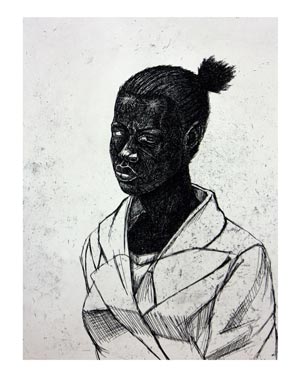
The drawings of the figure (Study for Souvenir I)" and the flower arrangement (Study for Souvenir III)" are preliminary sketches for elements of two of the four major paintings shown in the Renaissance Society installation. The paintings are now in the permanent collections of the Museum of Contemporary Art, Chicago and San Francisco Museum of Modern Art, respectively.
Our exhibition featured the suite of five "Black Power Prints" from 1998. These relief prints relate to the original oversized stamp sculptures exhibited in Chicago. They reveal the power of rhetoric and words for mobilizing people during the Civil Rights Movement with incendiary rally cries such as, "By Any Means Necessary," "Black Power," and "Burn Baby Burn" (shown below).
Black Power, 1998
A set of five relief prints, 25.5 x 40 inches Ed/5 POR
Click on any image to enlarge.
The centerpiece of the exhibition was the sculptural edition, "Souvenir: Composition in Three Parts, 1998-2000" (shown at the top of the page and below), which is a replica of the cruciform sign from the 16th Street Baptist Church in Birmingham. The kitschy painted plastic sign is like many others that grace African American churches nationwide, and comes complete with an overblown arrangement of plastic flowers. What makes Marshalls interpretation so powerful is the addition of a shelf holding a folded placard reading, AS SEEN ON TV and, on the wall, a framed video still of the arrangement as shown on television.
Through this composition Marshall turns what could be a sappy memorial to lost lives into a charged indictment of the lack and inaccuracies of media coverage of the events of 1963 as well as pointing out the levels of experiential detachment such biased media coverage engenders.
Souvenir: Composition in Three Parts, 1998-2000
Enamel on plastic, wood and glass shelf with steel bracket
and chain, plastic flowers, ribbon and framed video still
98 x 32 x 22 inches POR
Click on any image to enlarge.
MEMENTO, 1996
7-color lithograph with gold powder
30.25 x 44.25 inches Ed/33 POR
Click on any image to enlarge.
In the Memento series, Susan Snodgrass writes that Marshall creates "a requiem for a tumultuous era and its martyrs, the show reminds us of what was lost and gained during those years and what is yet to be realized now, when the struggle for racial equality has grown diffuse and resistance has resurfaced."
Below is a series of dinner plates created for the Renaissance Society in Chicago. The plates feature popular 1960s slogans that trace the civil rights movement: from "We Shall Overcome," the name of a hymn associated with the nonviolent strategies of Martin Luther King Jr., to "Black Power," the title of the late Stokely Carmichael's (a.k.a. Kwame Turre) black nationalistic manifesto.
In 1997 Marshall was awarded a John D. and Catherine T. MacArthur Foundation grant. In 1996 he received the Civtella Ranieri Foundation Fellowship and the American Academy of Arts and Letters Award in Art. He has also been the recipient of the Louis Comfort Tiffany Foundation (1993); Illinois Arts Council Fellowship (1992); National Endowment for the Arts, Visual Arts Fellowship (1991); and the Studio Museum in Harlem Resident Fellowship (1985).
Having declared early on that each figure he painted would be black and each image would be one "that spoke directly to the issue of blackness," Marshall has created dramatic and arch narrative works that bring about collisions between white middle-class iconography and symbols of black culture both genuine and imposed. And he has deliberately linked his work to art's grand tradition, subtly alluding to such masters as Rembrandt and Jacob Lawrence.
- Donna Seaman, Copyright American Library Association
NAT SHANGO from the collection of Greg Kucera and Larry Yocom
In the "Nat Shango" painting, Marshall retells the story of Nat Turner and the infamous slave rebellion. Covers of dime store romance novels depicting young white women are collaged into the clouds above the moonlit landscape of the farm. They serve as a reminder of the forbidden objects of beauty which tormented him. Turner is depicted as Shango, the African God of thunder and warfare. In this narrative Marshall has replaced Shango’s double edged ax with two hatchets. The freshly chopped stump of a tree in the foreground suggests the emasculation and thwarted desires created by racism.
Marshall’s paintings often employ classical art themes and compositional references from art history. He received his BFA from Otis Art Institute in L.A. in 1978, having taken considerable course work in art history. Marshall has been included in prestigious exhibitions at the Chicago Cultural Center, High Museum of Art, and the Corcoran Gallery in Washington, D.C. He has been production designer for several films, including Daughters of the Dust.
In 1994, Cleveland Center for Contemporary Art, Ohio, organized an exhibition of his work entitled Telling Stories, Selected Paintings, which traveled to Gallery of Art, Johnson County Community College, Overland Park, Kansas; Gallery 210, University of Missouri, St. Louis; Pittsburgh Center for the Arts, Pennsylvania; and Southeastern Center for Contemporary Art, Winston-Salem, North Carolina.
View of Marshall's past installation at Documenta X
Museum and Public Collections
Whitney Museum of Art,
New York
Museum of Contemporary Art, Chicago
Studio Museum in Harlem, ny
Arkansas Art Center, Little Rock
Art Bank Santa Monica Arts Commission, CA
Loyola Law School, Los Angeles
Laguna Art Museum, CA
Wadsworth Atheneum, Boston
Los Angeles County Museum of Art, Los Angeles
Corcoran Gallery of Art, Washington, D.C.
Denver Art Museum
St. Louis Art Museum
Johnson County Community College, Overland Park, KS
University of Arizona Museum of Art, Tucson
Art Institute of Chicago
Legler Branch Chicago Public Library, Chicago
Selected Collections
Dain Bosworth Inc., Los
Angeles
The Contemporary Museum, Honolulu
Peter & Eileen Norton Family Foundation, Santa Monica
The MacArthur Foundation, Chicago
Lewis Manilow Foundation, Chicago
Mc3D, Chicago
Principal Financial Group, Des Moines
Progressive Corporation, Cleveland
Seattle Art Museum
Sheldon Memorial Gallery, Lincoln, Nebraska
San Francisco Museum of Modern Art
Pearl C. Woods Gallery, Los Angeles
Marshall lives in Chicago, where he is professor of art at
University of Illinois and makes his home with his wife Cheryl.
"I persist, trying to make
pictures that inscribe black existential realities without sacrificing
a sense of majesty.
I'm driven by a desire to meaningfully provoke others' curiosity, to paint without
cynicism.
I still believe in mastery; in the service of imagination it can exceed the
limitations of circumstance." - Kerry James Marshall