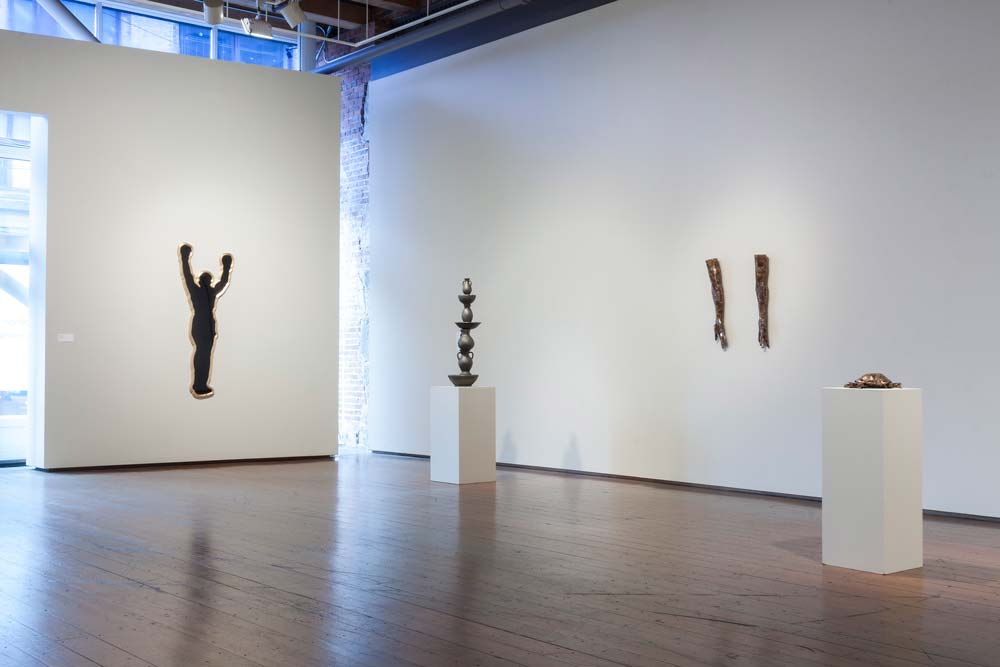
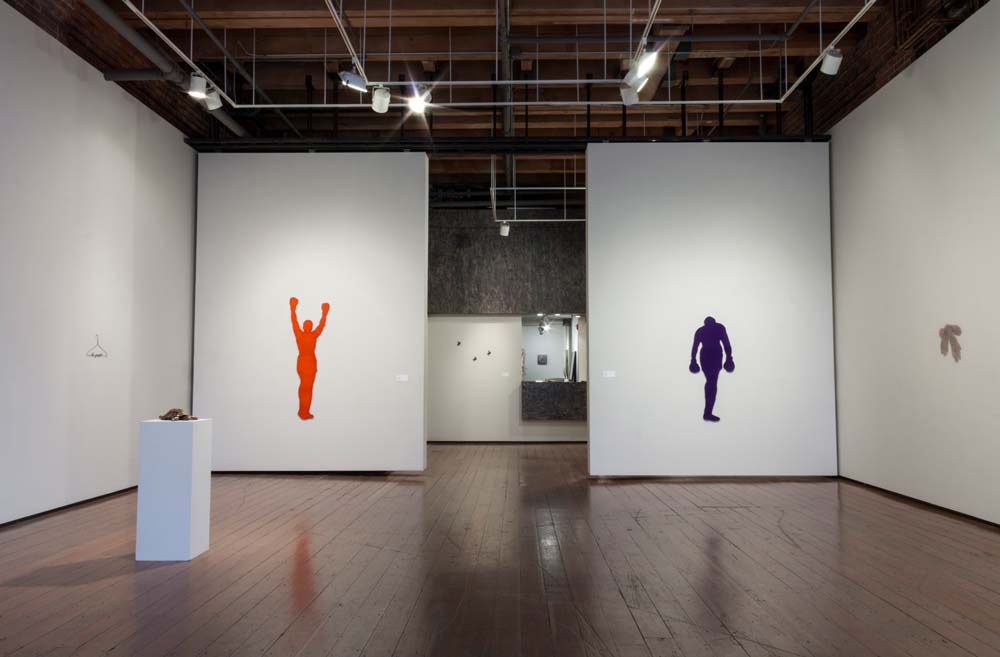
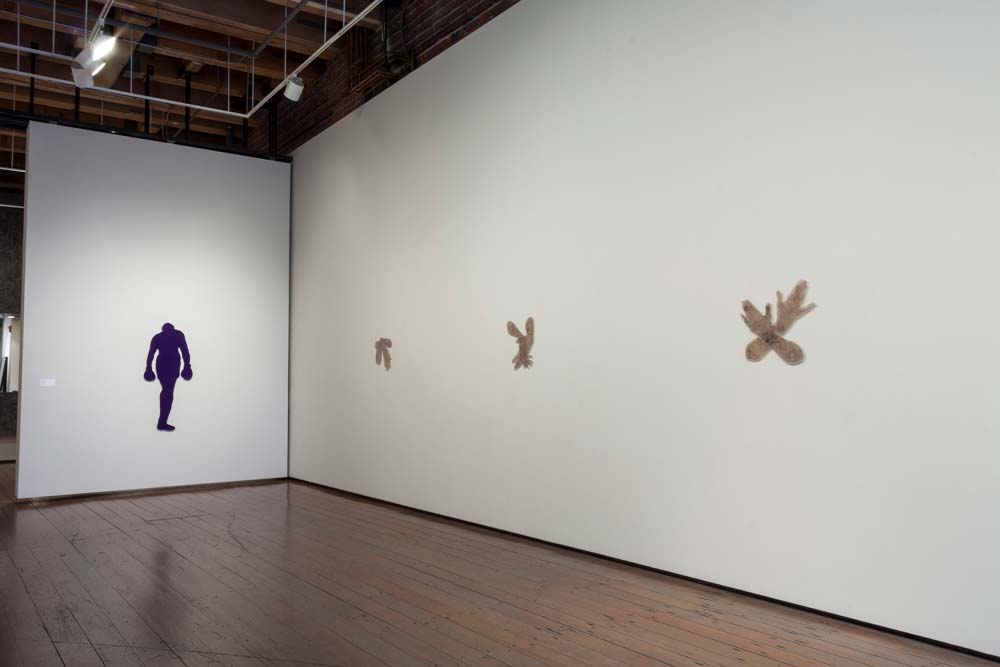
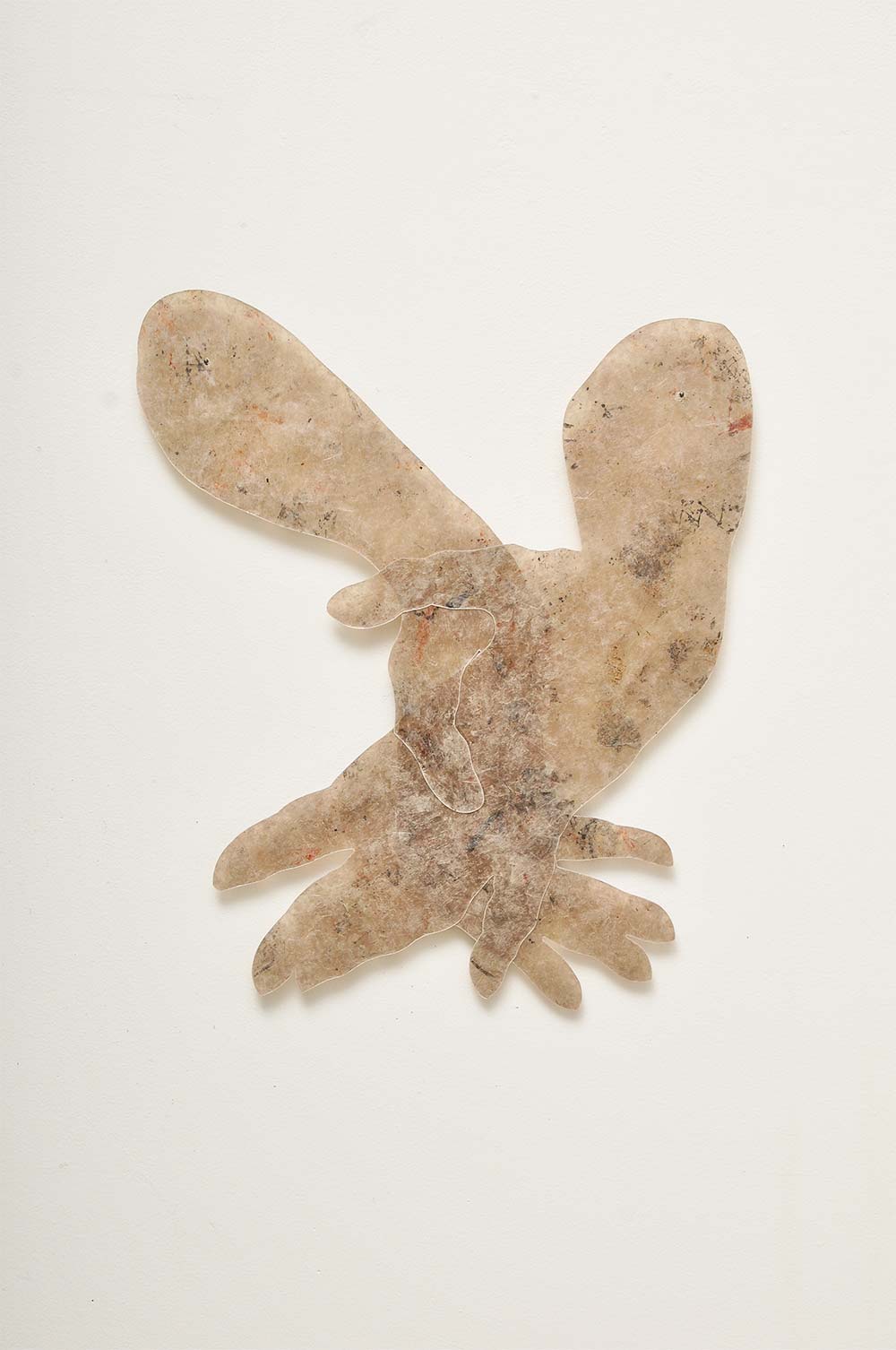
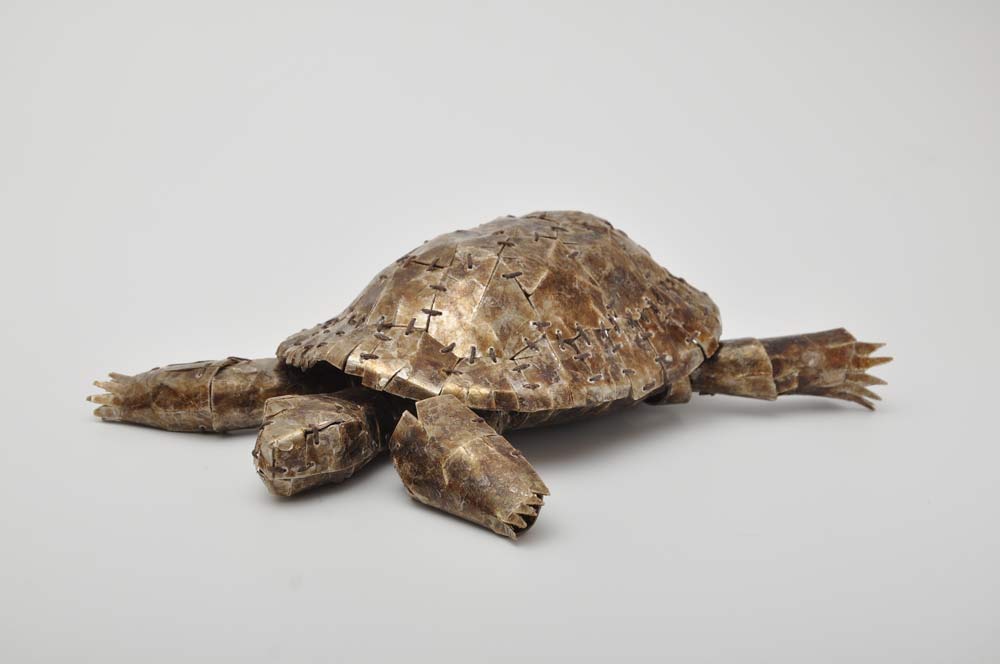
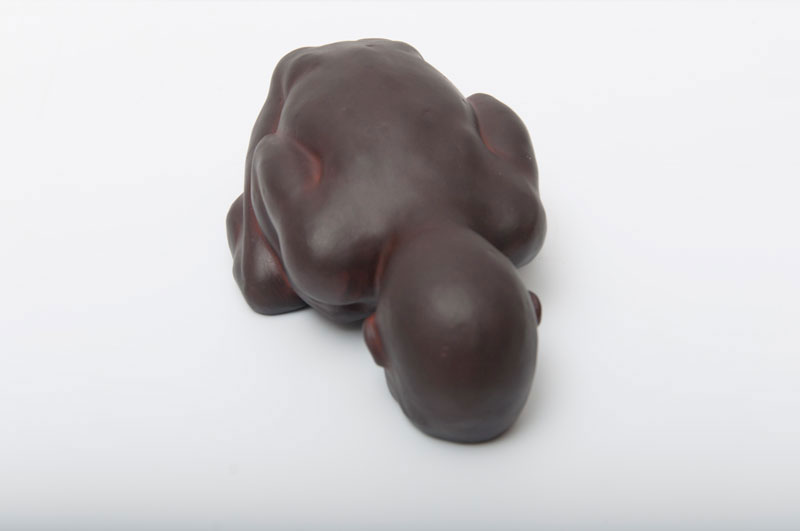
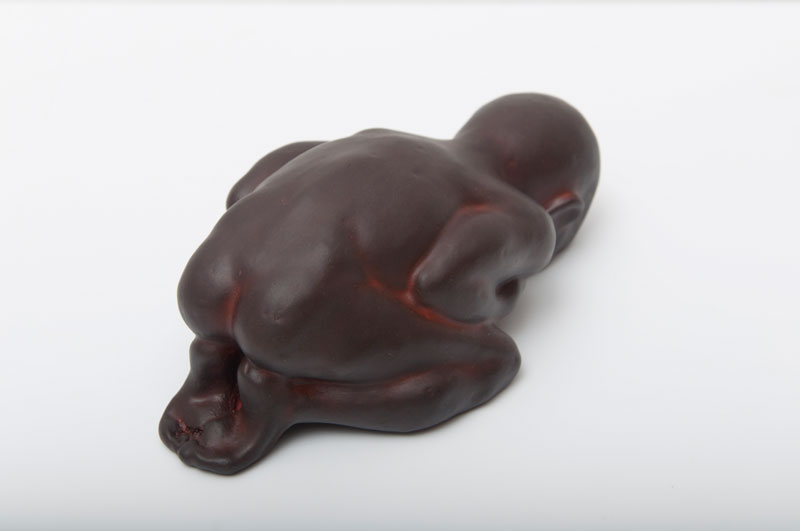
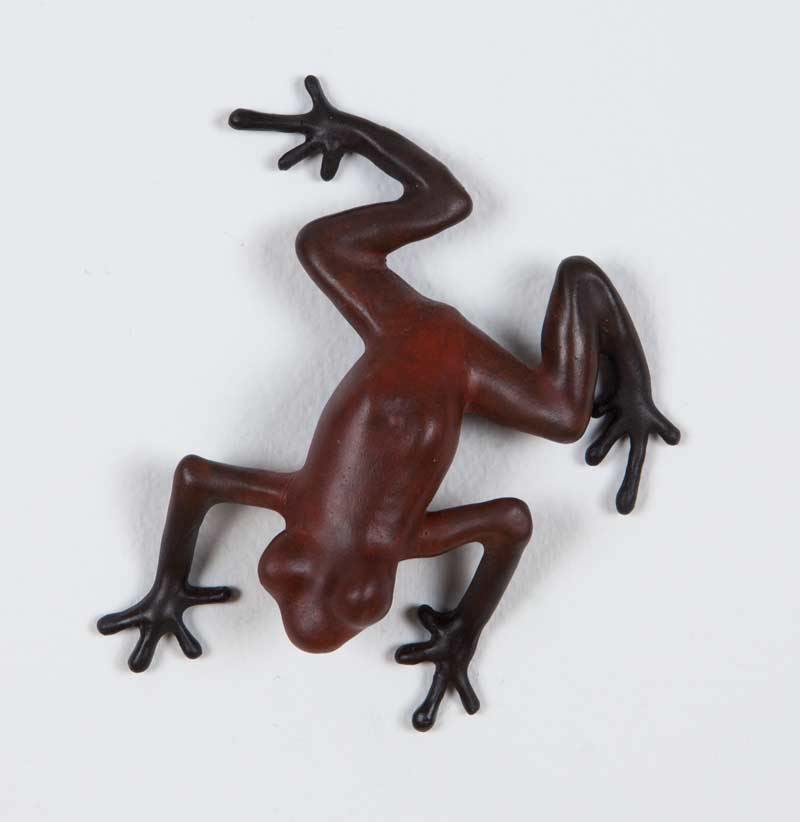
"My influences are many. Some I am aware of, and others still go unrecognized. African sculpture, Japanese aesthetics, Mexican folk arts, nature, personal experience and relationships, family, music, Christian art (both Gothic and Medieval) and other artist's creations, are some major influences I draw from. I do not like to create images that read as only one thing, but try to create works that have both power and mystery."
click on an image to enlarge:
View 1
View 2
View 3
Nocturne (octopus), 2007 Cast bronze, 23 x 28 x 29 inches
Ed/8 $18,000
click on an image to enlarge:
RISE, 2005
Cast lead with steel pedestal, 8 x 8 x 8 inches
Ed/10
$3,000
CASCABEL, 2003 (two views of the piece above)
Cast bronze with gold plating on a forged steel base 6 x 5 x 3 inches, base: 1.75 x 6.25 x 6.25 inches Ed/4
$2,000.
Bronze
click on an image to enlarge:
FLORIBUNDA, 1998 (shown installed at right)
Cast bronze, 26 x 30 x 30 inches
Ed/3, each varies in patina finish $24,000.
Abstractions based on the hair of Buddha - a tightly coiled pattern of curls in one and a topknot in another. Others reflect the graduated cylindrical shape of temples in Southeast Asia, or perhaps a wasp's nest. All of these forms are made of cast gypsum-based cements mixed with acrylics. These have been cast in the artist's own studio and then patinated. The coloration derives from being submerged in various chemical compounds and then exposed to heat prior to application of other chemicals. They are massive looking yet hollow and lightweight enough to hang on a metal bracket on a standard wall. A few similarly heroic scaled works in cast bronze will also be wall-hung, while some more massive works will be situated on the floor.
A smaller cast bronze shelf piece takes the shape of a pair of small crucibles joined together. It has been patinated through the natural evaporation of liquids to form horizontal lines expressing the decreasing levels of chemicals along the inside volume of the shapes.
MANDORLA, 2003
Cast bronze with patina, 31.5 x 14 x 8 inches, Ed/5
$6,000.
Details below:
Calderon's cast bronze pieces using the material to its greatest advantage without succumbing to the seductive qualities inherent in the media. This oversized gourd-like shape relates to Buddha's head and has an undulating leaf-shaped top-knot.
In the past Calderon's work has relied heavily on a distressed, worn or aged-looking surface. In contrast, several of the new sculptures feature a synthetic or industrial looking finish. A few of the pieces were cast in bronze at the Walla Walla Foundry while Calderon worked there on a Residency Grant from Centrum Foundation. Other works involve woven tree bark, brass and lead sheeting, inflated rubber inner tubing, cowhide, pigskin and a curious naturally occurring ball-like shape created by tree branches rolled by waves at the ocean's edge.
MADRINA (bronze), 2001
Cast bronze with patina, 57 x 20 x 20 inches, Ed/5 $24,000.
SOLD OUT
Details below:
Each work in this edition will be hand finished with a unique patina. A rich reddish brown appears in the crevices of this work.
The image is a reflection on the female figure. Her mystery is evident in the realization that, as the viewer moves around her, a face never appears. Instead, she is shrouded in 360 degrees with long tendrils of curled hair and a gown that is fluted with a scalloped bottom edge. She can be viewed as an abstraction of a Madonna figure but her curls also suggest the Buddhas of the Far East with their pin curls or topknots, and Grecian caryatids with their plaited hair.
"Madrina" is the Spanish word for godmother.
BULLA, 1997
Patinated, cast bronze, 16 x 10 x 7 inches, Ed/5
$4,500.
Mark Calderon completed a large-scale bronze outdoor sculpture which was installed at the entry driveway of the Burke Museum at the University of Washington. More recently, Calderon was the recipient of the 2001 Joan Mitchell Foundation Painters and Sculptors Grant. Also this year, Calderon was awarded a public commissions through the Seattle Arts Commission (he also received one in 1994). He has also been the recipient of numerous Seattle Artists awards.
Seen above, PLUMA was a commission for the public drive-through space at the entrance to the Burke Museum at the University of Washington in Seattle. The bronze sculpture measures 7 feet tall by 10 feet wide and was installed in 1999.
He received a LEAD, Art in Public Places commission in 1996 and has created public commissions for several community and school projects through the Washington State Art Commission. Calderon has been awarded artist residencies at Walla Walla Foundry in Walla Walla, WA; Bulls eye Glass Factory in Portland, OR; Pilchuck School in Stanwood, WA; and Centrum Foundation in Port Townsend, WA. He has been the recipient of artist grants from Artist Trust, Seattle and Art Matters, NY. The artist was the recipient of the 1993 WESTAF/NEA Regional Fellowship for Visual Arts Award, as well as the Seattle Art Museum's 1986 Betty Bowen Award, an annual award given to a promising young artist of the Northwest.
Above is PLUMA installed in Calderon's 1999 exhibition, prior to its permanent installation at the Burke Museum.
Calderon's work is included in several prominent public and private collections, including: Philadelphia Museum of Art, Seattle Art Museum, Microsoft Corporation, Redmond, WA, SAFECO Corporation, Seattle, and Tacoma Art Museum, WA, Boise Art Museum, ID, Clark College, Vancouver, WA, . His sculpture has been featured in a one-person exhibition at Eastern Washington University, Cheney and San Jose State University, as well as in group exhibitions such as the Boise Art Museum's Fabricated Nature, Tacoma Art Museum's Big Objects, and Reencuentros/Reencounters, Museo de Arte Contemporaneo in Chile. Calderon's work has been shown at Jamison/Thomas Gallery in Portland and New York, as well as at Nancy Hoffman Gallery in New York.
Iron
click on an image to enlarge:
FLUME, 1997
Cast iron with graphite finish, 10.5 x 14.5 x 3 inches
$2,400.
FLORUS, 1997
Cast iron with graphite finish, 9.25 x 14 x 3 inches
$2,400.
FEMINA, 1997
Cast iron with graphite, 16 x 11.75 x 1.75 inches
$2,400.
COPA, 1997
Cast iron with graphite finish, 9.25 x 14 x 3 inches
$2,400.
CURA, 1997
Cast iron with graphite finish, 15 x 10.5 x 1.75 inches
$2,400
Flame-Sprayed Steel
click on an image to enlarge:
CRONUS, 1996
Flame-sprayed steel shell over Styrene and cement, 27 x 34 x 34 inches
$7,500.
Steel
click on an image to enlarge:
CAVUS, 1996
Steel and rope, 18 x 36 x 19 inches
$3,500.
Tin and Synthetic Hair
click on an image to enlarge:
ANGELITO No. 5, 1995 (detail showing braids at right)
Tin and braided hair, 12.25 x 6.25 inches
$1,800.
ANGELITO No. 4, 1994
Tin and hair, 8 x 12 inches
$1,800.
Tin and Mixed Media
click on an image to enlarge:
WAITING VESSEL, 1992
Lead, iron and sandstone, 39 x 19 x 18 inches, $3,500.
BRUNT, 1990
Mixed media, 58 x 40 x 40 inches
$6,000.
BRUNT is a large black rubber balloon inflated within the confines of a metal cage.
TOFT, 1990
Mixed media, 45 x 32 x 32 inches
$3,800.
VENUS, 1990
Mixed media, 28 x 20 x 20 inches, $4,800.
BRIDE MONEY, 1989 (detail at right)
Lead and mixed media, 51 x 25.5 inches, Ed/5
$900.
LUNA (red/blue), 1987
Mixed media, 74 x 100 inches
$6,500.
"I was born of a Mexican father and an American mother of Norwegian-Irish descent, and was raised without much specific religious or ethnic influence. Later, during my college studies, I was exposed to many artists and cultures with which I was previously unfamiliar. Only recently have I recognized the influence of the Chicano aesthetic in my work. The rich and varied textures of the materials used in the construction of my work call to mind the important function crafts play in the daily life of the Mexican people. Commonplace materials such as plaster, wood, muslin, steel, tarpaper and cheesecloth are used as integral rather than incidental components of the work and provide a warmth and approachability, which might not be there if I used other media. These materials, often in an old and weathered condition, are an integral part of my work and through the use of these raw and varied textures, I hope to give the pieces an appearance and quality which resists placement in time and position within any specific culture.
The discovery of Victorian mourning jewelry has also made a lasting impression on my work and me. I was fascinated to learn that 100 years ago it was customary to use the hair of a loved one to weave intricate jewelry and decorations as a keepsake or as a memorial. The degree of intimacy that is achieved by using the physical reminders of a loved one is profound. This reinforced my belief that the material and process used can contribute a great deal of meaning to the work.
Much of my work has been quite abstract but recently, I have begun to make direct reference to the rich history Christian images: the cross, the heart, and the torso. These images, so significant in Chicano culture, are for me a representation of individual spirituality rather than the dogmas of any particular religion. For me, spiritual belief and practice is very personal. Nonetheless, the influence was there.
Because of this, my understanding of the creative act has also changed. Originally, I felt my art was affected only by outside influences, quite separate from my life and personal history. As my work and my artistic personality have developed, I began to realize how inseparable they are from my personal heritage."